
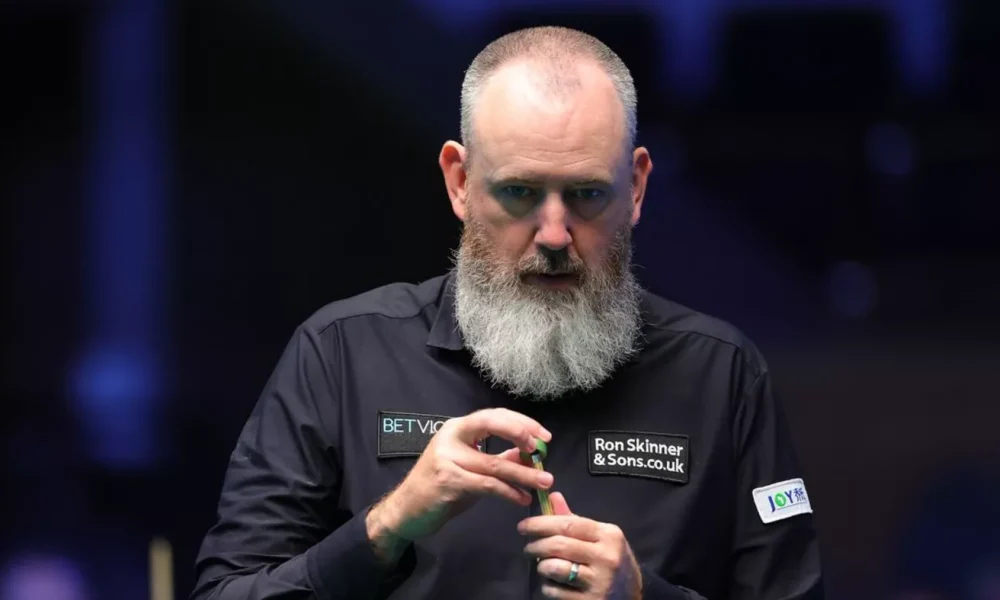

Mark Williams has suggested that so many top 16 players have lost early at the Northern Ireland Open because of the tiered-entry system.
Williams is one of only two members from the elite bracket of the rankings who have made it through to the last 16 at the Waterfront Hall in Belfast.
The 2017 champion remains on course to capture a 28th career ranking crown after beating Zhang Anda 4-2 on Wednesday.
Many of the headlines this week, however, have revolved around a string of defeats for the tournament’s marquee names.
Zhao Xintong, Judd Trump, Mark Selby, Ronnie O’Sullivan, Neil Robertson, and Shaun Murphy were among the stars who bowed out in round one.
John Higgins and defending champion Jack Lisowski quickly then fell at the second hurdle.
Williams thinks that the reason is simple, with lower-ranked players feeling match sharp having had more opportunities to play this season.
For several years, the World Snooker Tour adopted a flat draw system that saw most events begin in round one with all 128 tour players.
But in recent times, there has been a shift back toward a tiered system with higher ranked players entering in later rounds and often avoiding a qualifying competition altogether.
This has led to plenty of criticism from some sections of the circuit who believe the system provides protection to those at the top.
But Williams firmly disagrees, insisting that those further down the pecking order now boast the opportunity to safeguard their earnings before reaching a venue, thus relieving plenty of the pressure that was previously on their shoulders when they finally challenge the seeds.
“It’s quite simple,” Williams told the World Snooker Tour when asked why so many top 16 players had lost early this week.
“You’ve got a block of qualifiers with the top 16 seeded through to the venue, which is good. But the top 16 can’t get easy draws any more.”
“Every time you play someone, it’s someone who has won a few matches and a really good player.
“As you’re qualifying for the venue, there are some good draws out there. But the top 16 can never get a good draw in this system.
“They all go on about, you know, ‘they are seeded and they are looked after’ – what a load of bullcrap. Do you know what I mean?
“The top 16 didn’t get put there. They earned their way there, and now all of a sudden, flat draws are coming back in. Who cares what draw it is.
“It’s good and bad [tiered draws]. The good of it is, the players are playing amongst their own rankings and lower rankings.
“By the time they do come to the top 16, they’ve got their points. They’re not under so much pressure. That’s why a lot of the top 16 get beat now.
“If you put them in round one at the 128, the people who are £30 or £40-grand before the top 16 come in, I can guarantee you wouldn’t be on that money.”
Next up for Williams, who was a runner-up to Ali Carter at the English Open this season, will be Martin O’Donnell.
The three-time world champion from Wales has repeatedly claimed over the course of the last few years that he doesn’t practice much, instead saving his efforts for the tournament week itself.
His relaxed attitude has helped to prolong his career among the highest echelons, although there are still some who think he is telling porkies when it comes to his dedication to practice.
“People don’t believe me anyway,” Williams quipped. “I may as well just say I’m practicing in the house four hours a day. It’s easier, isn’t it?”
“So I practice Monday to Friday 10am until 4pm, 10am ’til 2pm on a Saturday, and I have Sunday off for Sunday lunch.
“Then I’m back at it again on a Monday.”
Featured photo credit: WST


Williams is right to point out they’ve earned their status. That said, many times we have situations where the seeds progress in great number despite the sharpness of the qualifiers.
[Williams is one of only two members from the elite bracket of the rankings who have made it through to the last 16 at the Waterfront Hall in Belfast.]
Well that answers a question I asked earlier about this event.
Williams is obviously correct in that good players, or players currently in good form, are the ones who make it through qualifying — to that you have to add the fact that snooker is a game of precision, a game of millimeters — so upsets can easily happen.
I think it unlikely flat draws for ranking events will make a comeback — the WST is a business, and I’m sure that certain names draw larger TV audiences — while as this event shows, a tiered draw is no guarantee that the big names will make into the latter stages of an event, where TV audiences are no doubt the largest, it just wouldn’t do to have them often eliminated in qualifying.
Seeding/exemption from qualifying is a kind of merit system — a hierarchy among the players — something for those further down the rankings to aim for.
>I think it unlikely flat draws for ranking events will make a comeback
A good example of why a flat draw SHOULD NOT make a comeback is the QF match between Dave Gilbert and Williams — it was Gilbert 4 – 2 Williams, before Williams won 4 consecutive frames to win the match — Gilbert had a nice lead, but just did not have the snooker ability AND competitive mettle to take advantage of that and win the match.
Players like Williams and others who via their consistently superior results show they have both snooker skills and competitive toughness should not have to go through qualifying — hierarchy is natural.
Unfortunately there is another factor in the results this week: the Home Nations events just aren’t a priority anymore. In this case, the Northern Ireland Open marks ther return of UK events after a few weeks away. Some players have taken time off, but many have been playing lucrative events in Asia. Nice though the Waterfront is, it’s not in the same league as the venues in Shenzhen, Hangzhou or Changsha. A number of players have just returned, probably still jaded. It’s no coincidence that the Chinese players have underperformed here – they may be wishing they were still back in their home country.
Top players will get used to tiered draws, and how to prepare. In the short term, any change to the schedule will bring some disruption, and some unexpected results. When the Home Nations events were first introduced in 2016, top players struggles to assert themselves. After a couple of years they had regained their advantage.
We need to see a larger sample size of results before we draw any conclusions. The English Open this season boasted a stronger lineup than the one we’re going to see this week in Belfast. Sometimes it’s just one of those statistical anomalies, and a wider narrative doesn’t need to be attributed to it.
The Belfast venue is definitely not an issue. Many players regard it as one of their favourite venues.
And top players don’t need anytime to get used to tiered draws as they’ve never completey been eradicated.